When procurement teams, fire department commanders, industrial safety managers, and emergency response planners evaluate robotics in firefighting, the conversation has moved well beyond remote water spraying. In 2026, the real procurement question is whether a robot can enter a burning petrochemical facility, maintain traction on foam-covered concrete, pull a charged hose 300 meters, operate continuously near extreme heat, and—when the situation demands—grip, lift, crush, or clear obstacles that block firefighter access. For buyers comparing fire fighting robot manufacturers, the difference between a standard suppression robot and a combined fire rescue and demolition robot is not a minor specification gap. It is the difference between a tool that sprays water from a distance and a system that can actively change the outcome of a complex fire rescue scene. Handler's fire fighting robot and fire rescue and demolition robot represent both ends of this capability spectrum, and this guide will help B2B buyers understand exactly what to evaluate before committing to either platform.
The most dangerous moment in a firefighting robot deployment is not the purchase decision—it is the moment the robot enters a real fire scene and the specification gaps become operational failures.
Fire scenes are not controlled test environments. A robot deployed at a petrochemical tank fire faces radiant heat that can exceed 500°C at close range, foam and water-covered floors that destroy traction, debris and collapsed structural elements that block movement, smoke that blinds cameras, and hose drag loads that stall underpowered crawlers. If any single subsystem fails under these conditions, the robot stops being an asset and becomes an obstacle.
The failure modes of low-specification firefighting robots in real deployments are consistent and predictable:
Crawler tracks slip on wet concrete, foam-covered floors, or loose rubble, leaving the robot stranded before it reaches the fire source
Battery or engine performance degrades rapidly under thermal stress, cutting working time from the rated specification to a fraction of what the buyer expected
Hose towing capacity is insufficient for the actual hose diameter and length required at the incident
Water cannon range and flow rate are adequate for demonstration conditions but fall short under real fire suppression demands
Mechanical arm—if present—lacks the payload, reach, or tool options to move dangerous objects, clear debris, or create access paths
Remote-control signal degrades or fails inside industrial structures, tunnels, or reinforced buildings
No environmental monitoring means operators are making decisions without gas, temperature, or smoke data from inside the danger zone
Spare parts are difficult to source, creating extended downtime after the first serious deployment
For B2B buyers in municipal fire brigades, petrochemical safety teams, airport emergency services, tunnel operators, and industrial park management, these failures translate directly into firefighter exposure risk, delayed suppression, failed rescue access, and procurement decisions that cannot be defended in a post-incident review.
The key message for procurement teams is this: the best firefighting robot is not the one with the highest listed water flow. It is the one that keeps moving, keeps communicating, keeps cooling, and keeps working under real fireground stress—and when the scene demands it, can also grip, lift, break, and clear.
Before evaluating specifications, buyers need a clear understanding of what each product category is designed to do and where each one fits in an emergency response capability plan.
Robotics in firefighting covers a broad range of remote-controlled and semi-autonomous systems designed to support fire suppression, rescue, reconnaissance, ventilation, demolition, hazardous-material response, and operation in areas where human entry carries unacceptable risk. Within this category, there are two meaningfully different product types.
A standard fire fighting robot is primarily a remote suppression and reconnaissance platform. Its core functions are:
Remote-controlled movement across difficult terrain
High-flow water or foam delivery to the fire source
Hose towing to extend fire attack range
Reconnaissance and video feedback for command teams
Environmental monitoring for gas, smoke, and temperature data
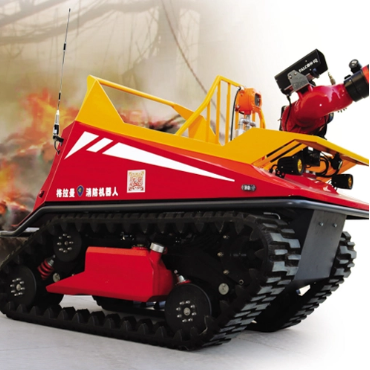
Handler's standard fire fighting robot is built around an all-terrain hydraulic crawler chassis powered by an 18 kW imported diesel engine. It carries U.S. Amiron 3480+5178 high-flow fire cannons delivering 120 L/s water flow with a 90 m water range and 70 m foam range. The system includes a reconnaissance module, wireless image acquisition, environmental monitoring, long-distance data transmission, and imported traction winches. Key performance figures include 8.5 km/h travel speed, 35° climbing ability, and a minimum 800 m remote-control distance.
A fire rescue and demolition robot combines all the suppression capability of a standard fire robot with active mechanical rescue and obstacle-removal functions. This is the platform buyers need when the incident requires more than water delivery.
Handler's fire rescue and demolition robot is powered by a 78 kW air-cooled diesel engine—more than four times the power of the standard model—and adds a 5-degree-of-freedom mechanical arm capable of gripping loads over 200 kg with a five-claw grip diameter exceeding 800 mm. The demolition system includes a crushing hammer operating at 800–1400 bpm. The robot can tow 300 m of DN80 filled waterbelt, delivers 70 L/s automatically adjustable water gun flow with a 75 m range, and provides 60,000 m³/h air exhaust and water mist flow above 420 L/min.
| Evaluation Factor | Standard Fire Fighting Robot | Fire Rescue and Demolition Robot |
|---|---|---|
| Primary function | Fire suppression and reconnaissance | Suppression + rescue + demolition |
| Engine power | 18 kW diesel | 78 kW air-cooled diesel |
| Water flow | 120 L/s | 70 L/s adjustable |
| Water range | 90 m | 75 m |
| Hose towing | Imported traction winch | 300 m DN80 filled waterbelt |
| Mechanical arm | Limited or absent | 5-degree-of-freedom, 200 kg+ grip |
| Demolition tool | Not standard | Crushing hammer 800–1400 bpm |
| Grip diameter | Not applicable | Over 800 mm five-claw |
| Climbing ability | 35° | 35° |
| Remote-control distance | 800 m minimum | 800 m visual |
| Best deployment | Large-area suppression, hazardous monitoring | Complex rescue, obstacle clearing, demolition support |
The procurement decision between these two platforms should be driven by the incident types the buyer's organization most frequently faces—and the worst-case scenarios they must be prepared for.
Understanding how each subsystem contributes to overall fireground performance helps buyers ask better questions during supplier evaluation and write more defensible tender specifications.
Crawler traction is the foundation of everything else. A robot that cannot move cannot suppress, cannot rescue, and cannot justify its procurement cost. For robotics in firefighting, crawler performance must be evaluated under conditions that reflect actual deployment environments—not clean factory floors.
B2B buyers should request evidence of crawler performance across:
Wet concrete and foam-covered surfaces
Gravel, rubble, and collapsed structural debris
Mud and industrial-site ground conditions
Slope climbing at the rated angle under load
Hose-drag resistance with a filled hose at the rated diameter and length
Obstacle-crossing height with the robot at operational weight
Turning radius in narrow corridors or between storage tanks
Track wear resistance after extended deployment
Track tension adjustment and field replacement procedure
Handler's crawler chassis uses a hydraulic all-terrain design with 35° climbing ability on both the standard and rescue-demolition models. For tender documents, buyers should specify the slope angle, surface type, and load condition under which climbing performance must be demonstrated—not just the angle in isolation.
Heat resistance claims are among the most frequently overstated specifications in firefighting robot procurement. When a supplier claims operation at 500°C or above, buyers should not accept the claim without structured verification.
The correct approach is to request:
Maximum ambient temperature test report with test distance from flame specified
Radiant heat exposure test report with duration and intensity documented
Continuous working time at the specified temperature under the test conditions
Thermal shielding material specification and thickness
Cooling method used during the test (spray cooling, insulation, or both)
Heat resistance ratings for cables, cameras, hydraulic hoses, and sensors
Engine or power system thermal protection design
Post-test inspection results showing component condition
Warranty terms that specifically address high-temperature exposure damage
Without this evidence, a 500°C+ claim is a marketing statement, not a procurement specification. Buyers who accept unverified heat resistance claims risk deploying a robot that fails in the first serious high-temperature incident.
For buyers considering a fire rescue and demolition robot, the mechanical arm and demolition tooling are the differentiating capability. The evaluation should cover:
Rated gripping weight under static and dynamic conditions
Number of degrees of freedom and the operational flexibility they provide
Arm reach at full extension and at rated payload
Five-claw grip diameter and compatibility with common obstacle types
Crushing hammer strike frequency and impact energy
Tool attachment options and field replacement time
Hydraulic system pressure and flow supporting arm operation
Arm stability when lifting heavy objects on sloped or uneven ground
Control precision for delicate operations such as oil drum transfer
Handler's rescue-demolition robot provides a 5-degree-of-freedom arm with over 200 kg gripping capacity, a five-claw grip diameter exceeding 800 mm, and a crushing hammer at 800–1400 bpm. For buyers writing tender specifications, these figures provide a useful baseline for minimum performance requirements.
A procurement decision based only on water flow and remote-control distance will miss the subsystem failures that cause robots to underperform in real deployments. Serious buyers should evaluate every major component.
| Component | What to Check | Why It Matters |
|---|---|---|
| Heat-resistant body | Thermal shielding material, insulation thickness, coating | Protects internal components near fire |
| Crawler chassis | Track material, hydraulic drive, slope ability, obstacle crossing | Determines mobility on difficult terrain |
| Power system | Engine power, cooling design, continuous runtime | Supports sustained operation |
| Fire monitor | Water flow, foam flow, range, adjustability | Determines suppression effectiveness |
| Hose towing system | Towing capacity, winch type, hose diameter compatibility | Critical for long-distance fire attack |
| Mechanical arm | Degrees of freedom, payload, reach, tool options | Enables rescue, gripping, demolition |
| Demolition tool | Hammer frequency, impact energy, attachment speed | Supports access creation and debris clearing |
| Camera system | Visible, thermal, low-light, pan-tilt range | Helps remote operators navigate safely |
| Environmental monitoring | Gas detection, smoke, temperature, video data | Supports safer command decisions |
| Remote control | Distance, anti-interference, feedback delay | Critical for safe operation in structures |
| Cooling system | Spray cooling, thermal insulation, component protection | Extends high-temperature working time |
| Maintenance access | Track replacement, filter access, hydraulic inspection | Reduces lifecycle service cost |
The standard model integrates an all-terrain hydraulic crawler chassis, 18 kW imported diesel engine, U.S. Amiron high-flow fire cannons at 120 L/s with 90 m water range and 70 m foam range, reconnaissance system, wireless image acquisition, environmental monitoring, long-distance data transmission, and imported traction winches—all in a 1800 × 1100 × 1400 mm body traveling at up to 8.5 km/h.
The rescue-demolition model upgrades to a 78 kW air-cooled diesel engine, adds a 5-degree-of-freedom mechanical arm with 200 kg+ gripping capacity and 800 mm+ five-claw diameter, provides 300 m DN80 filled waterbelt towing, delivers 60,000 m³/h air exhaust, water mist above 420 L/min, and 70 L/s adjustable water gun flow at 75 m range, with crushing hammer operation at 800–1400 bpm.
Robotics in firefighting serves a wide range of high-risk operational environments:
Petrochemical plants and oil depots
Fuel storage and tank farm facilities
Warehouses and large logistics parks
Road and rail tunnel fires
Underground facilities and parking structures
Power generation plants
Airport emergency response
Chemical manufacturing plants
Municipal fire brigades
High-rise building support operations
Hazardous-material incident response
Shipyards and port facilities
Mine and confined-space rescue
Disaster rescue and demolition scenes
Keeps firefighters farther from extreme heat, toxic smoke, and explosion risk
Enables remote suppression in zones where human entry is not safe
Supports reconnaissance before human teams enter the danger zone
Pulls hoses into hazardous areas, extending fire attack range
Improves access in debris-filled or structurally compromised fire scenes
Supports demolition and obstacle clearing when equipped with mechanical tools
Reduces manual exposure during oil drum transfer or hazardous-object removal
Provides strong tender value for municipal and industrial emergency procurement
Expands emergency response capability beyond standard fire truck platforms
Supports long-term modernization of industrial and municipal fire response
For buyers researching the best fire rescue and demolition robot specifications, the following checklist covers the four critical evaluation domains:
All-terrain crawler chassis with hydraulic drive
Slope climbing ability at rated load
Obstacle-crossing height specification
Turning radius in narrow operational spaces
Hose towing capacity at rated hose diameter and length
Track heat and wear resistance rating
Ground clearance under operational load
Stability during arm operation on uneven ground
Water flow rate at rated pressure
Foam flow rate and foam type compatibility
Water cannon range at rated flow
Foam range at rated flow
Water mist capability and flow rate
Fire monitor adjustability and remote control
Hose diameter compatibility
External water source connection options
Mechanical arm degrees of freedom
Rated gripping weight under load
Five-claw grip diameter
Arm reach at rated payload
Crushing hammer strike frequency and impact energy
Cutting or shearing force if applicable
Tool replacement time in field conditions
Stability under maximum lifted load
Dangerous-object transfer capability
<h4 style="margin: 1.5rem 0px
 Xuzhou Handler 2024 ''Climbing New Heights'' New Year GalaAugust 22, 2022After the joyous Year of the Rabbit, we welcome the time of the Dragon Year. On the occasion of the Spring Festival, Helenzhe Company will hold a grand celebration to welcome the Lunar New Year of the...view
 Gramme Shines at INTERSEC, Highlighting New Trends in FirefightingApril 7, 2025Recently, the globally renowned security event—the Middle East Dubai Security and Fire Exhibition (Intersec) has once again attracted worldwide attention. As the largest and most influential security...view
 HANDLER First 64M Ultra-High Aerial Work Platform at the Shanghai Bauma ExhibitionDecember 2, 2024On November 26, 2024, the Shanghai Bauma Exhibition and Shanghai International Construction Machinery, Building Material Machinery, Mining Machinery, Construction Vehicles, and Equipment Expo opened gra...view
 HANDLER: Set Sail and Create a New Chapter Again!October 16, 2024Yesterday, a batch of advanced aerial work vehicles from HANDLER was fully assembled and ready to be shipped to Malaysia, marking a steady advance in the company's international development strate...view
 The Role of Emergency Vehicles in Disaster Response and ManagementApril 9, 2024Emergency vehicles play a vital role in disaster response and management, providing fast and efficient assistance in times of crisis. From ambulances to fire trucks to specialized rescue vehicles, the...view
 Warm Congratulations to the 38th Anniversary Celebration of Malaysia Mobile Crane Owners AssociationJune 4, 2025On April 26, 2025, the Malaysia Mobile Crane Owners Association (1987) grandly held its 38th anniversary celebration at Monkeys Canopy Resort. This anniversary celebration, themed "United Progres...view